
A couple of winters ago, when I was living in central Vancouver Island, I woke in my quiet house to the sound of a bird’s song drifting through an open window. 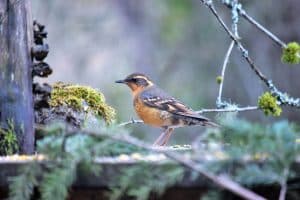 Part of the backyard canopy of maples, red alders, and trembling aspens included a fifty-foot black locust tree, right in the center of the yard. Although it is considered to be aggressively invasive, it is also breathtakingly beautiful. This bird enticing tree with its gnarled twisty branches – thorned like a rose, and delicate limey olive like leaves leave a tremendous, sometimes dangerous mess come its autumn shed. Its drooping cream coloured, pea-like flower clusters bloom for only one week every late May. These highly fragrant flowers are similar to that of a mock orange, graciously permeating a two block radius. This king tree of the neighbourhood, crowning above any other tree, has been the highlight of my garden for me. It’s only competition in height are the black cottonwoods which line the rivers in town. It sheds its cottony seeds from April through to June.
Often crows and non-native starlings loiter in the tree, but if I’m lucky, and with my birding book near, I may spot the occasional rare sight.
Light shone between the slats of the blinds, I could see only a hint of blue in a grey sky. I am used to birds in this tree, but I had never heard this song before, a one-note song, a simultaneous hum and whistle, first in one pitch, then following, a higher or lower pitch, a straight yet wavering tune. This lovely sound cut through the damp, grey winter morning like a horn announcing a season change. It took about five whistles to get me out of bed and to the window; it wasn’t leaving quickly, and I was passionately curious.
I couldn’t spot this intriguing feathered visitor, so I walked to the kitchen and tiptoed past the windows. Near the sliding glass door, I slowly scanned the trees only to find him sitting on the bare wisteria covered pergola, I had never seen anything like it. A bird that resembled a robin but was privileged in bright burnt orange. His colours shone like a beacon in the dismal, wet coastal landscape.
The male has a black, grey, blue band around its breast, an orange belly, orange markings throughout the wings and an orange eye stripe.
The female shares somewhat similar markings but duller. Her upper body and breast band are brown to brownish grey, with brown wing feathers. Her throat, chest, and eye stripe a burnt orange. According to my beloved birding book, this beautiful bird is a varied thrush.
The varied thrush is slightly bigger than most thrush, measuring in at roughly 7.5 to 10 inches but generally closest in size to its relative, the robin. However, it sports a shorter, heavier build. It is most commonly seen throughout their migration in winter.
The varied thrush breeds on the west coast of North America, ranging from Alaska as far down as northern California. Its altitudinal migrations are in winter, where it nests in dense, mossy, coniferous forests, mostly at high elevations in Alaska, Canada, and in the mountains of Washington and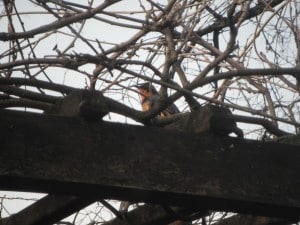 Oregon. The female varied thrush builds a bulky, open nest five to fifteen feet above ground in a crotch of a conifer tree. She lays, if possible; twice in one season, roughly two to five eggs at a time. Only she incubates, though both parents take on the duty of feeding. To defend territory, the male will sing triumphantly.
In the winter, they either migrate to northern California or retreat to towns, orchards, gardens, and back yards in search of berries, fruit, and seeds from shrubs, trees, the ground, and feeders. In rarity, they have been seen in flocks of up to twenty, but it is more common to see a group or a lone bird flying southeast to a warmer climate.
Much like the robin, a thrush’s foraging is mostly done on the ground. In the summer, the thrush feasts on plump garden worms, backyard insects, and other invertebrates. When the coolest winter days have passed and the sign of spring is on its way, most varied thrushes regain their homes in the thick woodlands where they announce spring with their songs. Some follow retreating snow lines up the mountain while others fly north for a cooler spring and summer.
I was honoured to have this handsome bird visit my urban central Vancouver Island backyard and even more so when he returned five days in a row. Its presence ramped up my hobby of birding. I started religiously keeping the feeders clean and full of a variety of food. I obsessively peeked out the window at the black locust to see who was visiting throughout the day, with my bird book and binoculars within reach, I was ready to spot and identify any feathered friends who might stop off in my yard. I am grateful for gardens and urban vegetation, especially the urban tree canopy. Without these, such visits might not be as abundant.
Thrushes give birdwatchers joy from admiring their beautiful colours, markings, and their songs that cut through the west coasts dreariest season. I only hope you, too, will spot one soon and be as captivated as I was by this beautiful bird.